
Hartpury University and College: smart remote sensor monitoring for enhanced calf welfare
By Nadia Henrique-Murray
Maintaining high standards of calf welfare at a busy university farm once meant relying on periodic observation and reactive responses to health issues. See how Hartpury University and College has benefited from continuous environmental monitoring and smart sensor technology to take a more proactive, evidence-based approach to calf health management, improving welfare outcomes.
24/7 monitoring
temperature & humidity across calf housing
Early intervention
through data-led insights
Improved calf health
and optimised husbandry
Hartpury University and College manages a mixed commercial farming operation across multiple sites, including dairy, beef, sheep, and arable systems, alongside its specialist land-based education and research programmes, supporting the UK agricultural sector. At the heart of this is the Digital Innovation Farm, where new technologies are tested and evaluated in real farm conditions.
Bringing together farmers, researchers and industry partners, the Digital Innovation Farm focuses on generating practical insights that can be applied on the farm. This includes using data and technology to better understand animal health, welfare and performance, supporting informed decision-making for farming businesses.
The challenge
Hartpury’s team was already maintaining high standards of animal welfare, but wanted to explore ways to go further, particularly for their calves.
The impetus came from a small number of pneumonia cases among the calves. Pneumonia is not uncommon in cattle, but the team, working alongside vets, wanted to understand the contributing factors and take a proactive, evidence-based approach to reduce risk. The question was whether environmental conditions within the calf housing might be playing a role, and if so, how these could be better understood and managed.
They focused specifically on temperature and humidity levels and wanted to find solutions to monitor them more precisely and continuously.
The solution
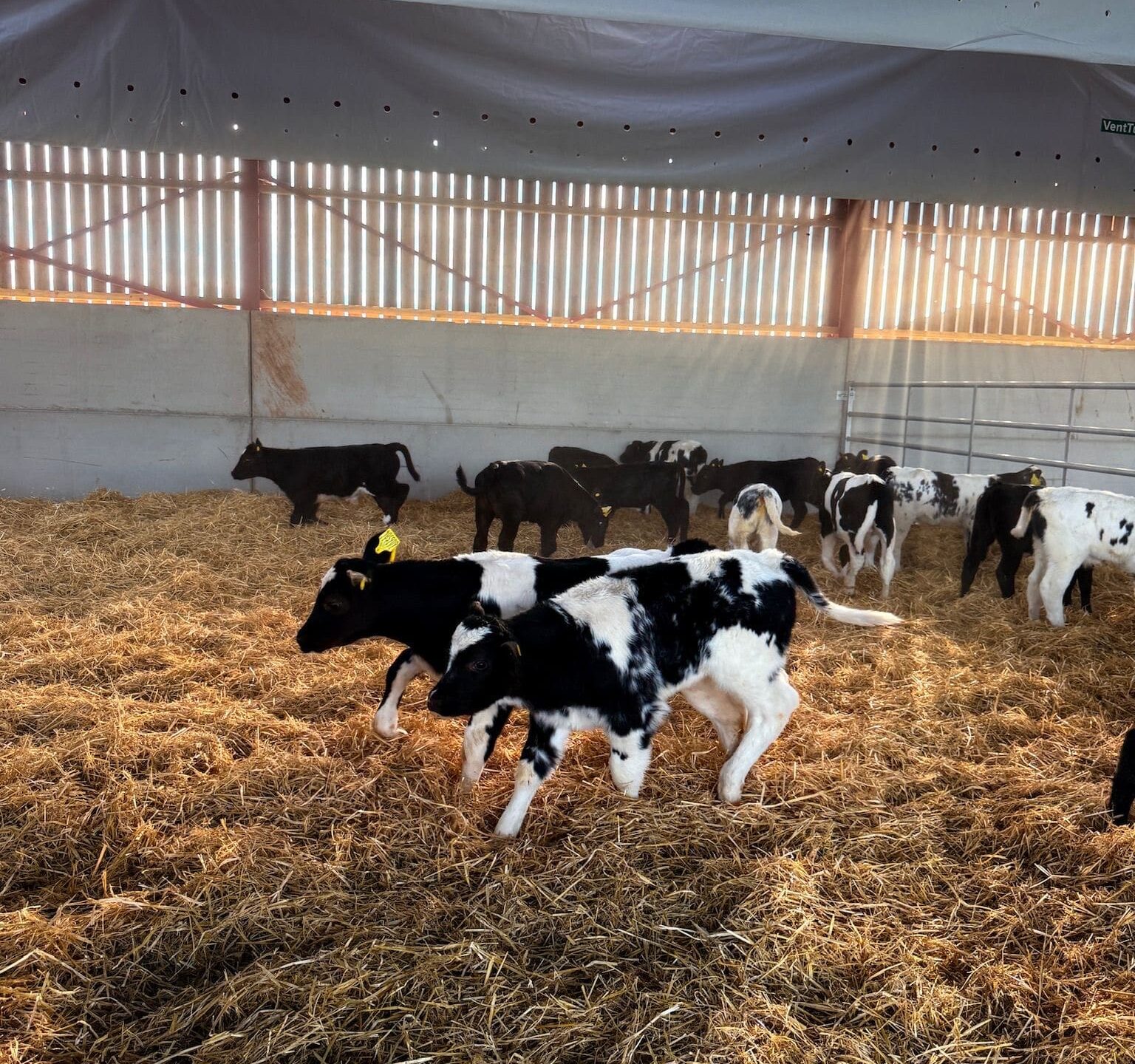
skentel installed a network of temperature and humidity sensors across the dairy sheds and calf igloos, providing continuous environmental monitoring. Data from the sensors was transmitted automatically to a central cloud-based dashboard, giving the Hartpury team the ability to view live readings at any time, as well as track trends.
In more remote or rural locations, establishing data connectivity for sensor networks can require additional infrastructure. However, the on-site 5G Wi-Fi network already in place at Hartpury allowed seamless data transmission.
Results
With continuous monitoring in place, the team was able to identify patterns that would have been difficult to detect through periodic observation alone: conditions inside the igloos were found to be warmer and more humid than expected. When calves moved from these environments to the cooler outdoors, the sharp difference in temperature was identified as a likely contributing factor to the health issues the team had observed.
On the back of these insights, Hartpury made two practical changes: reducing the number of calves housed per igloo below the standard recommendations and increasing the frequency of straw bedding changes. These adjustments helped to optimise temperature and humidity conditions.
This data-led approach supported improved calf health outcomes and demonstrated the value of using real-time monitoring to inform and enhance day-to-day management decisions.
“The skentel system was quick to install with no disruption to day-to-day operations. Using the dashboard provided us with the analytics necessary to draw our own evidence-based conclusions, giving us greater visibility of environmental conditions and enabling more informed, data-led decision-making.”
Neave Anderson
Head of Agri-tech & innovation, – Hartpury University and Hartpury College
Request a Connectivity Assessment
Get a free, no-obligation outline of what you could monitor and control remotely, with potential benefits tailored to your business’ specific needs and goals..