
Satellite connectivity for remote monitoring: anywhere, anytime.
By skentel
In an increasingly connected world, one fundamental challenge has persisted: how do we monitor and manage assets in locations where traditional cellular networks simply do not reach? Satellite Communication can solve this, and a new protocol makes it cheaper, easier to use, and more practical for remote monitoring.
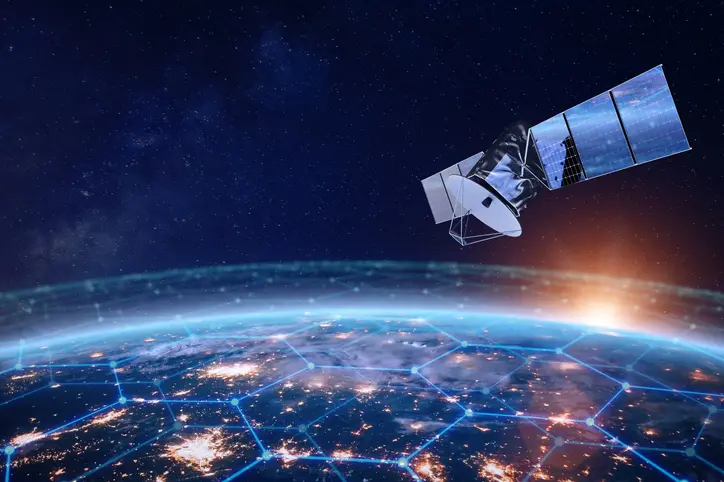
For many applications, long-range wireless technologies like LoRaWAN can bridge the gap where cellular coverage falls short. However, even LoRaWAN eventually runs into practical and economic barriers. These might be caused by too small a population of remote devices to justify the cost of installing and maintaining gateways, a lack of infrastructure to connect those gateways back to the internet, difficult geography, or infrequent usage that makes dedicated gateway deployment uneconomical.
From remote agricultural operations to offshore energy infrastructure, from mining sites in isolated locations to environmental sensors in pristine wilderness areas, there remain places where neither cellular nor LoRaWAN can provide practical connectivity. For organisations operating in these truly remote locations, satellite connectivity powered by 3GPP NTN (Non-Terrestrial Networks) is delivering global coverage for remote asset monitoring.
What is 3GPP NTN?
3GPP Non-Terrestrial Networks represent a shift in how we think about wireless connectivity. Rather than treating satellite communications as a completely separate technology requiring specialised equipment, 3GPP NTN integrates satellite communication with terrestrial networks as part of the 5G ecosystem.
Think of it as extending your cellular network into space. The same standardised 5G protocols that could power a smartphone can now connect IoT devices (Internet of Things devices; sensors and equipment that send data wirelessly) via satellites orbiting overhead. This standardisation means devices can transition between regular cellular coverage and satellite connectivity without requiring separate hardware.
The technology uses satellites at different heights above Earth: LEO (Low Earth Orbit) satellites orbit 500-2,000 km above the planet, offering lower power requirements, while GEO (Geostationary) satellites sit at approximately 36,000 km, providing stable coverage over large geographic areas.
How does 3GPP NTN work?
The system adapts existing 5G standards to overcome the unique challenges of satellite communication, primarily the vast distances involved and the fact that satellites are constantly moving (except for geostationary satellites).
In regular terrestrial networks, the time it takes for a signal to travel is very short. With satellites, that time is much longer because the signal needs to travel to space and back. The technology handles this through sophisticated timing mechanisms that account for satellite motion and distance.
The satellites themselves can work in different ways. Some act as simple radio repeaters, bouncing signals between the device and ground-based infrastructure. More advanced implementations place complete 5G base stations on the satellites themselves.
For IoT applications specifically, the system supports NB-IoT NTN, a version optimised for low-power, small-data transmissions. This is perfect for remote monitoring where devices might send a few readings per day rather than continuous streams of data.
Key advantages of 3GPP NTN
- True global coverage: Connect assets literally anywhere on Earth, from remote farmland to offshore platforms, mountain ranges to desert locations.
- Ultra-low power consumption: Battery-powered sensors can operate for years without replacement, making deployments practical in locations that are difficult or expensive to access regularly.
- Standards-based technology: Unlike proprietary satellite systems, 3GPP NTN is built on global standards with a clear evolution path, ensuring long-term compatibility and avoiding vendor lock-in.
- Hybrid capability: Devices can operate on regular cellular networks where available and seamlessly switch to satellite in remote locations, providing the best of both worlds with a single technology
- No recurring per-device fees: Unlike traditional satellite services with expensive per-device subscription costs, 3GPP NTN solutions can offer more economical pricing models.
The future of 3GPP NTN
The satellite IoT market is experiencing rapid growth, and 3GPP NTN is now in commercial deployment with ongoing improvements from multiple vendors. As the technology matures, we are seeing expanding coverage across different regions, improved power efficiency for even longer battery life, and growing device availability as more manufacturers adopt the standard.
Target applications of 3GPP NTN
Agriculture: Soil moisture sensors, livestock tracking, and irrigation system monitoring across vast pastoral properties where cellular coverage does not exist.
Energy and utilities: Pipeline monitoring, remote tank level sensing, solar farm performance tracking, and renewable energy system monitoring in off-grid or off shore locations
Mining: Equipment monitoring, environmental compliance sensors, and safety system connectivity at remote mine sites.
Environmental monitoring: Weather stations, water quality monitoring, and wildlife tracking in protected areas, national parks, and other pristine wilderness locations.
Infrastructure: Remote bridge sensors, ground movement, flood monitoring systems, and traffic management in rural areas beyond the reach of traditional networks.
About skentel
At skentel, we are early adopters of 3GPP NTN technology, actively developing satellite connectivity solutions for remote asset monitoring. We recognised that this technology represents a fundamental shift in what is possible for truly remote monitoring applications.
Our approach combines cutting-edge satellite connectivity with practical integration. We work with industry-standard protocols like RS485 Modbus, meaning our solutions can connect with the sensors and equipment already deployed across many industries; no need to replace your existing infrastructure.
What makes our solutions different is the combination of global satellite coverage with standards-based technology. We are not betting on proprietary systems that may become obsolete. We are building on 3GPP standards with a clear evolution path and proven commercial deployments.
Whether you are managing remote agricultural land, monitoring offshore infrastructure, tracking environmental data in wilderness areas, or overseeing renewable energy systems in off-grid locations, we understand the practical challenges of working in truly remote environments.
If you are dealing with assets in locations where WiFi, cellular, and even LoRaWAN cannot reach, satellite connectivity may be the solution you need. We can help you determine whether 3GPP NTN is right for your application and design a system that delivers the connectivity and monitoring capabilities you need.
Ready to explore how satellite connectivity could benefit your remote operations? Speak to the skentel team about the possibilities.