
What is IoT Remote Monitoring? A Guide to Smarter Asset Management
By skentel
Organisations across the UK are discovering the power of IoT remote monitoring to transform how they manage their assets, energy consumption, and water usage. Whatever your industry or role, it offers a pathway to significant resource savings and environmental benefits. At its heart, remote monitoring delivers real-time data and actionable insights that help you make better-informed decisions, reduce waste, and operate more sustainably.
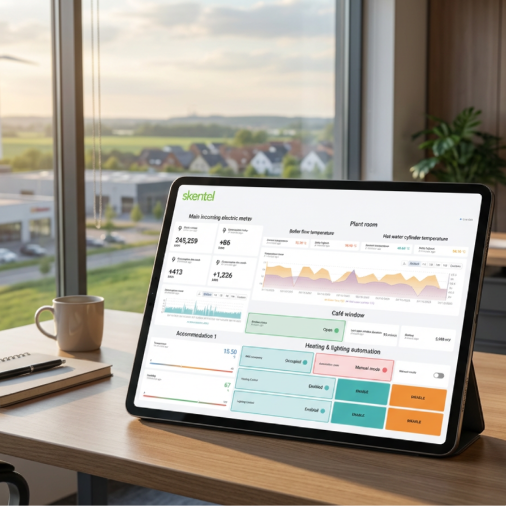
The three buildings block of IoT remote monitoring
1. Sensor Installation: The eyes and ears of your operation
Every IoT remote monitoring system begins with sensors: the devices that collect vital information about your assets and environment.
What Can Sensors Monitor?
The versatility of sensors means you can track virtually anything that matters to your operation:
- Energy consumption and output: Identify key sources of usage by breaking it down between different assets, equipment, or areas.
- Water usage and leaks: Track consumptions across different areas or assets and detect even small changes that indicate leaks
- Environmental conditions: Temperature, humidity, soil moisture, air quality, water levels, and more.
2. Connectivity: Getting your data where it needs to go
Once sensors collect data, that information needs to travel to a central system for processing and analysis. This is where connectivity comes in. The right option depends on your specific location, asset distribution, and coverage availability.
There are three primary connectivity options:
Cellular Connectivity
Cellular IoT connectivity takes advantage of networks and infrastructure already in place, offering ample global coverage. It is best for city-based operations and facilities in areas with strong mobile coverage.
LoRaWAN (Long Range Wide Area Network)
LoRaWAN enables deployment of large numbers of modules cost-effectively because they don’t require mobile subscriptions. It is best for rural locations, dispersed assets across large areas, and applications where long battery life is essential (agriculture, environmental monitoring).
Satellite Connectivity
When your assets are in very remote locations (mountains, oceans, deserts, forests) operating far outside cellular or WiFi coverage, satellite technology provides global connectivity. It is best for remote environmental monitoring, offshore installations, and agricultural operations without cellular access.
3. Cloud-Based Platform: Where data becomes insight
The final element is the cloud-based platform where all your data converges and is processed.
Real-Time Access and Visualisation
Sensors send real-time data back to custom dashboards where the information is under your control. This means you can monitor operations anytime, from anywhere by logging in to a cloud-based platform.
Bespoke Dashboard Design
The right cloud-based platform offers the flexibility to create custom dashboards tailored to your specific needs. Whether you need simple temperature readings or complex multi-parameter displays showing consumption across multiple sites, working with the right partner ensures your dashboard can be designed to show exactly what matters to your operation.
Intelligent Analytics and Automated Actions
The real power comes from what happens with your data. An effective platform acts as a central command centre, monitoring incoming data streams for patterns or deviations, triggering alerts and displaying information on dashboards for human observation and automated responses. Not all platforms offer this level of sophistication, so choosing the right solution is crucial.
Integration with Existing Systems
One of the most powerful features of advanced cloud platforms is their ability to connect with your existing business systems through APIs and integrations. This enables automated workflows that save time and reduce manual intervention. However, not all platforms provide seamless integration capabilities, which is why selecting the right technology partner matters.
IoT Remote monitoring applications by sector
For Hotels and Hospitality: Automatic room preparation triggered by booking system data: when a guest checks in or is due to arrive, lighting, temperature, and amenities are automatically adjusted. When they check out, systems switch to energy-saving mode.
For Agriculture: Automatic alerts when soil moisture levels drop below a threshold, notifying farmers when irrigation is needed.
For Environmental Monitoring: Water quality sensors that automatically alert authorities when pollution levels exceed safe limits, enabling rapid response to protect ecosystems and water supplies.
For Energy and Water Management: Automatic notifications when a building’s water consumption spikes unexpectedly, allowing quick investigation of potential leaks; Electricity monitoring that triggers alerts when demand approaches grid capacity or on-site generation limits, enabling load management decisions.
For Facilities Management: Predictive maintenance scheduling integrated with work order systems; Automated reporting for compliance and sustainability targets.
The Business Case: Cost Savings and Environmental Benefits
Implementing IoT remote monitoring delivers tangible returns that benefit both your bottom line and the environment. Examples include:
Cost Reduction
- Savings in utility costs by improving energy usage patterns.
- Savings in water costs by reducing leaks.
- Reduced manual monitoring labour and site visits.
Environmental Impact:
- Reduce CO2 emissions through optimised operations and resource management.
- Real-time data enables immediate response to leaks, waste, or inefficiencies.
Operational Excellence:
- Better decision-making enabled by continuous data streams rather than ad hoc data dips.
- Complete visibility across distributed operations.
- Predictive maintenance reduces downtime and extends asset lifespan.
Getting Started
Remote monitoring technology is becoming essential for organisations that want to operate efficiently, sustainably, and competitively. The three elements have to work together seamlessly: sensors collecting critical data, with connectivity delivering it reliably to a cloud based platform, to transform that data into actionable insights and automated workflows.
Success depends on partnering with the right technology experts: those with proven experience who can provide tailored advice, design solutions that suit your specific operational needs, and work with trusted partners to deliver results.
Whether you’re looking to reduce water waste, optimise energy consumption, protect environmental assets, or simply gain better visibility of your operations, remote monitoring offers a proven pathway to achieving your goals.
Ready to explore how remote monitoring could benefit your organisation? Speak to the skentel team about how they can help to design remote monitoring solution that fits your specific needs and goals.